Thursday, March 31, 2022

The Criminalization of Safety in Healthcare?


On March 25, 2022 a former nurse at Vanderbilt University Medical Center (VUMC) was convicted of gross neglect of an impaired adult and negligent homicide as a consequence of a fatal drug error in 2017.* 

Criminal prosecutions for medical errors are rare, and healthcare stakeholders are concerned about what this conviction may mean for medical practice going forward.  A major concern is practitioners will be less likely to self-report errors for fear of incriminating themselves.

We have previously written about the intersection of criminal charges and safety management and practices.  In 2016 Safetymatters’ Bob Cudlin authored a 3-part series on this topic.  (See his May 24, May 31, and June 7 posts.)  Consistent with our historical focus on systems thinking, Bob reviewed examples in different industries and asked “where does culpability really lie - with individuals? culture? the corporation? or the complex socio-technical systems within which individuals act?”

“Corporations inherently, and often quite intentionally, place significant emphasis on achieving operational and business goals.  These goals at certain junctures may conflict with assuring safety.  The de facto reality is that it is up to the operating personnel to constantly rationalize those conflicts in a way that achieves acceptable safely.”

We are confident this is true in hospital nurses’ working environment.  They are often short-staffed, working overtime, and under pressure from their immediate task environments and larger circumstances such as the ongoing COVID pandemic.  The ceaseless evolution of medical technology means they have to adapt to constantly changing equipment, some of which is problematic.  Many/most healthcare professionals believe errors are inevitable.  See our August 6, 2019 and July 31, 2020 posts for more information about the extent, nature, and consequences of healthcare errors.

At VUMC, medicines are dispensed from locked cabinets after a nurse enters various codes.  The hospital had been having technical problems with the cabinets in early 2017 prior to the nurse’s error.  The nurse could not obtain the proper drug because she was searching using its brand name instead of its generic name.  She entered an override that allowed her to access additional medications and selected the wrong one, a powerful paralyzing agent.  The nurse and other medical personnel noted that entering overrides on the cabinets was a common practice.

VUMC’s problems extended well beyond troublesome medicine cabinets.  An investigator said VUMC had “a heavy burden of responsibility in this matter.”  VUMC did not report the medication error as required by law and told the local medical examiner’s office that the patient died of “natural” causes.  VUMC avoided criminal charges because prosecutors didn’t think they could prove gross negligence. 

Our Perspective

As Bob observed in 2016, “The reality is that criminalization is at its core a “disincentive.”  To be effective it would have to deter actions or decisions that are not consistent with safety but not create a minefield of culpability. . . .  Its best use is probably as an ultimate boundary, to deter intentional misconduct but not be an unintended trap for bad judgment or inadequate performance.”

In the instant case, the nurse did not intend to cause harm but her conduct definitely reflected bad judgment and unacceptable performance.  She probably sealed her own fate when she told law enforcement she “probably just killed a patient” and the licensing board that she had been “complacent” and “distracted.”   

But we see plenty of faults in the larger system, mainly that VUMC used cabinets that held dangerous substances and had a history of technical glitches but allowed users to routinely override cabinet controls to obtain needed medicines.  As far we can tell, VUMC did not implement any compensating safety measures, such as requiring double checking by a colleague or a supervisor’s presence when overrides were performed or “dangerous” medications were withdrawn.

In addition, VUMC’s organizational culture was on full display with their inadequate and misleading reporting of the patient’s death.  VUMC has made no comment on the nurse’s case.  In our view, their overall strategy was to circle the wagons, seal off the wound, and dispose of the bad apple.  Nothing to see here, folks.

Going forward, the remaining VUMC nurses will be on high alert for awhile but their day-to-day task demands will eventually force them to employ risky behaviors in an environment that requires such behavior to accomplish the mission but lacks defense in depth to catch errors before they have drastic consequences.  The nurses will/should be demanding a safer work environment.

Bottom line: Will this event mark a significant moment for accountability in healthcare akin to the George Floyd incident’s impact on U.S. police practices?  You be the judge.

For additional Safetymatters insights click the healthcare label below.


*  All discussion of the VUMC incident is based on reporting by National Public Radio (NPR).  See B. Kelman, “As a nurse faces prison for a deadly error, her colleagues worry: Could I be next?” NPR, March 22, 2022; “In Nurse’s Trial, Investigator Says Hospital Bears ‘Heavy’ Responsibility for Patient Death,” NPR, March 24, 2022; “Former nurse found guilty in accidental injection death of 75-year-old patient,” NPR, March 25, 2022.

Wednesday, February 2, 2022

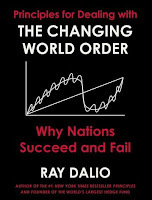
A Massive Mental Model: Lessons from Principles for Dealing with the Changing World Order by Ray Dalio

At Safetymatters, we have emphasized several themes over the years, including the importance of developing complete and realistic mental models of systems, often large, complicated, socio-technical organizations, to facilitate their analysis.  A mental model includes the significant factors that comprise the system, their interrelationships, system dynamics (how the system functions over time), and system outputs and their associated metrics.

This post outlines an ambitious and grand mental model: the recurring historical arc exhibited by all the world’s great empires as described in Ray Dalio’s new book.* Dalio examined empires from ancient China through the 20th century United States.  He identified 18 factors that establish and demonstrate a great society’s rise and fall: 3 “Big Cycles,” 8 different types of power an empire can exhibit, and 7 other determinants.

Three Big Cycles 

The big cycles have a natural progression and are influenced by human innovation, technological development, and acts of nature.  They occur over an empire’s 250 year lifetime of emergence, rise, topping out, decline, and replacement by a new dominant power.

The financial cycle initially supports prosperity but debt builds over time, then governments accommodate it by printing more money** which eventually leads to a currency devaluation, debt restructuring (including defaults), and the cycle starts over.  These cycles typically last about 50 to 100 years so can occur repeatedly over an empire’s lifetime.

The political cycle starts with a new order and leadership, then resource allocation systems are built, productivity and prosperity grow, but lead to excessive spending and widening wealth gaps, then bad financial conditions (e.g., depressions), civil war or revolution, and the cycle starts over.

The international cycle is dominated by raw power dynamics.  Empires build power and, over time, have conflicts with other countries over trade, technology, geopolitics, and finances.  Some conflicts lead to wars.  Eventually, the competition becomes too costly, the empire weakens, and the cycle starts over.

Dimensions and measures of power

An empire can develop and exercise power in many ways; these are manifestations and measures of the empire’s competitive advantages relative to other countries.  The 8 areas are education, cost competitiveness, innovation and technology, economic output, share of world trade, military strength, financial center strength, and reserve currency status.

Other determinants

These include natural attributes and events, internal financial/political/legal practices, and measures of social success and satisfaction.  Specific dimensions are geology, resource allocation efficiency, acts of nature, infrastructure and investment, character/civility/determination, governance/rule of law, gaps in wealth, opportunity and cultural values.

The 18 factors interact with each other, typically positively reinforcing each other, with some leading others, e.g., a society must establish a strong education base to support innovation and technology development.  Existing conditions and determinants propel changes that create new conditions and determinants.

System dynamics

Evolution is the macro driving force that creates the system dynamic over time.  In Dalio’s view “Evolution is the biggest and only permanent force in the universe . . .” (p. 27)  He also considers other factors that shape an empire’s performance.  The most important of these are self-interest, the drive for wealth and power, the ability to learn from history, multi-generational differences, time frames for decision making, and human inventiveness.  Others include culture, leadership competence, and class relationships.  Each of these factors can wax and/or wane over the course of an empire’s lifetime, leading to changes in system performance.

Dalio uses his model to describe (and share) his version of the economic-political history of the world, and the never-ending struggles of civilizations over the accumulation and distribution of wealth and power.  Importantly, he also uses it to inform his worldwide investment strategies.  His archetype models are converted into algorithms to monitor conditions and inform investment decisions.  He believes all financial markets are driven by growth, inflation, risk premiums (e.g., to compensate for the risk of devaluation), and discount rates.

Our Perspective

Dalio’s model is ambitious, extensive, and complicated.  We offer it up an extreme example of mental modeling, i.e., identifying all the important factors in a system of interest and defining how they work together to produce something.  Your scope of interest may be more limited – a power plant, a hospital, a major corporation – but the concept is the same.

Dalio is the billionaire founder of hedge fund Bridgewater Associates.  He has no shortage of ego or self-confidence.  He name-drops prominent politicians and thinkers from around the world to add weight to his beliefs.  We reviewed his 2017 book Principles on April 17, 2018 to show an example of a hard-nosed, high performance business culture. 

He is basically a deterministic thinker who views the world as a large, complex machine.  His modeling emphasizes cause-effect relationships that evolve and repeat over time.  He believes a perfect model would perfectly forecast the future so we assume he views the probabilistic events that occur at network branching nodes as consequences of an incomplete, i.e., imperfect model.  In contrast, we believe that some paths are created by events that are essentially probabilistic (e.g., “surprising acts of nature”) or the result of human choices.  We agree that human adaptation, learning, and inventiveness are keys to productivity improvements and social progress, but we don’t think they can be completely described in mechanical cause-effect terms.  Some system conditions are emergent, i.e., the consequence of a system’s functioning, and other things occur simply by chance. 

This book is over 500 pages, full of data and tables.  Individual chapters detail the history of the Dutch, British, American, and Chinese empires over the last 500 years.  The book has no index so referring back to specific topics is challenging. Dalio is not a scholar and gives scant or no credit to thinkers who used some of the same archetypes long before him.

We offer no opinion on the accuracy or completeness of Dalio’s version of world history, or his prognostications about the future, especially U.S.-China relations.

Bottom line: this is an extensive model of world history, full of data; the analyses of the U.S. and China*** are worth reading.


*  R. Dalio, Principles for Dealing with the Changing World Order (New York: Avid Reader Press) 2021.

**  If the new money and credit goes into economic productivity, it can be good for the society.  But the new supply of money can also cheapen it, i.e., drive its value down, reducing the desire of people to hold it and pushing up asset prices.

***  Dalio summarizes the Chinese political-financial model as “Confucian values with capitalist practices . . .” (p. 364)